Renew the retainer with a number
the client's finance team can audit.
You built the workflows and the agents. Someone in the client's finance team decides whether to keep paying for them. LumaTrack prices every run you ship at labor rates you can cite, subtracts what the automation costs to run, and keeps a white-labeled ledger per client where a closed month stops moving. By the time the renewal conversation happens, the math is already written.
White-label · per client · evidence-graded so a client CFO can audit it.
| productivity 96 h returned × $42.50 loaded rate | $4,080 |
| cost avoidance 22 support escalations deflected × $115 | $2,530 |
| hard 1 redundant SaaS subscription retired (invoice) | $1,188 |
| Gross value returned | $7,798 |
| LumaTrack, per-run & build costs | −$612 |
| Net value returned · Q1 2026 | $7,186 |
Illustrative client report · methodology-true. Every figure on it drills down to its formula and runs. One report per client; the roster behind it is the point.
Pilots stall where nobody can price the outcome.
The build goes well and the workflows run. Then the pilot reaches the point where someone has to justify the spend, and the strongest thing on the table is an execution count from the platform that gets paid when the number looks good. That is the conversation where retainers get trimmed and pilots quietly expire.
The platform grades its own homework
n8n Insights counts your executions. Zapier counts your tasks. Every one of those numbers is produced by the tool being evaluated, which is the first thing a client's finance team discounts.
Rebuilt by hand, every quarter
The ROI math that does get shown is a spreadsheet someone assembles the week before the review. It's slow, it changes shape between account leads, and a client's finance team can tell it was written to persuade them.
Your estate spans four tools
n8n here, Make there, a Claude agent, a cron job somebody wrote in 2023. The value lives across all of them, and no single vendor dashboard can add it up.
One ingest pipe per client. The report builds itself.
Add the client, mint a key
Create a managed org for the client in one step. It gets its own logins, its own API key, and its own walled-off data. No other client can see it, and the client can't see the rest of your roster.
Point the automations at it
Your n8n workflows, Make scenarios, agent runs and scheduled scripts already run. Each reports its runs with one call, and the published n8n node does it without any code at all. Failures count too: they cost money and the ledger says so.
curl -X POST https://lumatrack.io/api/v1/runs \
  -H "Authorization: Bearer lmt_redwoodhealth_..." \
  -d '{"automation": "intake-routing", "status": "success"}'
Send the client their report
Your brand, your color, your logo on a per-client value report. Share a no-login link for the review, or print it to PDF. Once a month closes it stops moving, so the number a client saw in Q1 is the same number in Q3.
A white-label value ledger for every client
Numbers finance will sign
Hard savings, cost avoidance, and returned time each stay in their own lane. Time saved is discounted by the conservatism factor a CFO would apply anyway. Every figure carries an evidence grade and drills to its formula and runs.
Every tool in one ledger
n8n, Make, Zapier, Claude and GPT agents, Ansible, GitHub Actions, plain curl. Token-priced AI runs sit in the same ledger as the workflow that called them, so the client sees one number.
Per-client, fully isolated
Each client is its own organization: own logins, own API keys, own automations, walled off from every other client and from you until you switch in to manage it.
Closed months stay closed
Once a month closes, its numbers stop moving. What a client saw last quarter holds, even after rates and assumptions change, which is what lets them audit the report instead of taking your word for it.
The pilot gets a verdict
Run the pilot against a baseline the client attested to, and the ledger answers the renewal question in dollars. If a workflow loses money, it says so, which is the answer that earns you the next engagement.
Your brand on everything
Your name, color, and logo on every shared value report. Send a no-login report link for the review, or revoke it the moment it should stop working. Branded client logins arrive with custom domains (on the roadmap).
The whole roster at a glance
One consolidated view across every client: value delivered, hours returned, and run volume, with each client metered on its own plan. Switch into any client to manage it without leaving the console.
This is what the client sees, under your brand.
This is the live ledger for one client, headed by your name, with every dollar traceable to the runs and rates behind it, so nobody rebuilds a slide the night before the review. Closed months stay put, and an assumption change posts as its own entry instead of quietly moving the past.
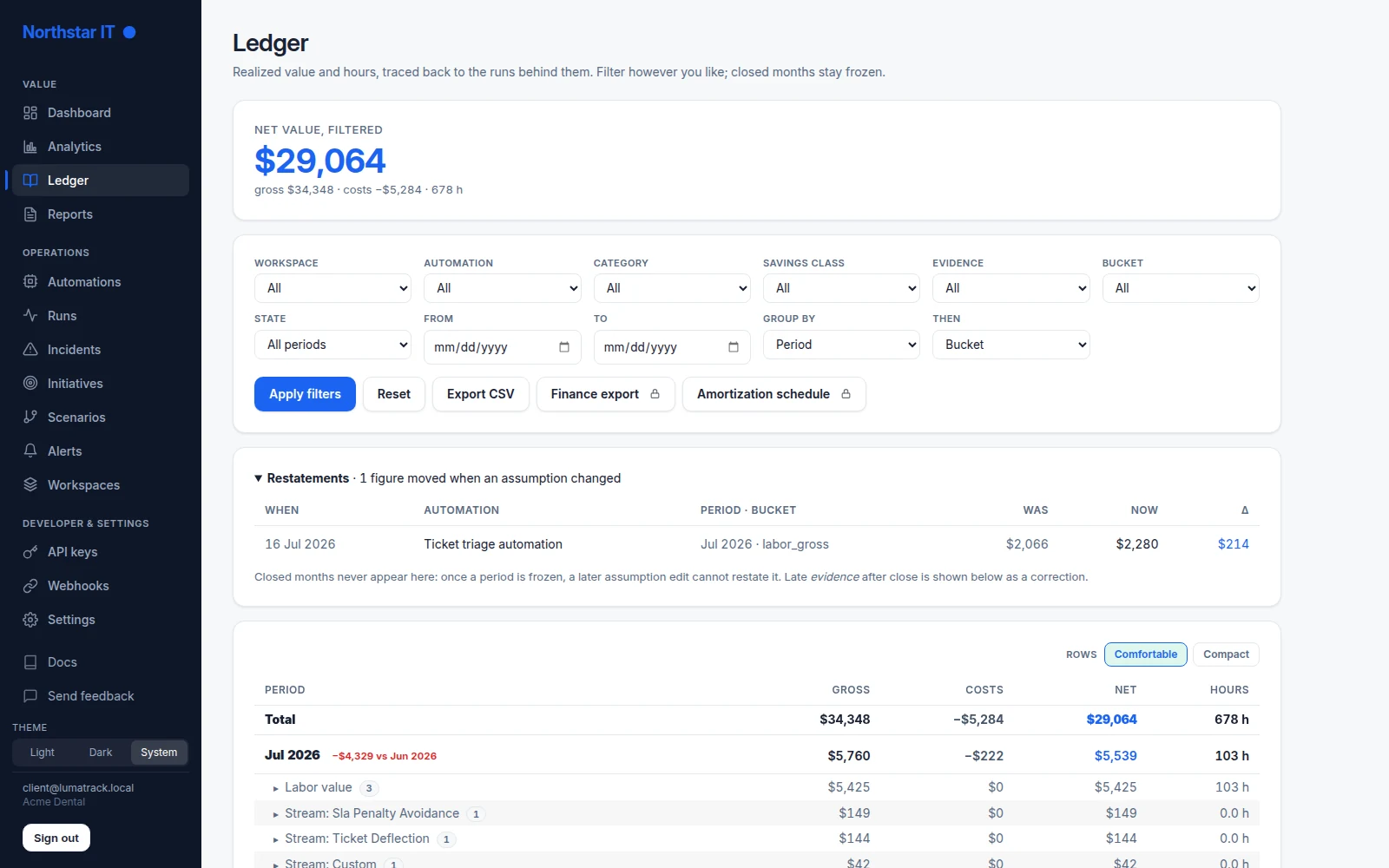
For an MSP, this page doubles as the QBR value slide. Get the free client report template →
Priced by the size of your roster
The billing unit is the managed client, because the unit of value is the client's review. Land cheap and expand as the roster grows. Your client pays you far more than $25 a month for the work this report defends.
- 5 managed client organizations included, then $25/client / month
- Each client isolated: own logins, API keys, automations
- White-label, per-client value reports built for the QBR
- Team-grade limits per client: 50 automations, 500k runs / month
- Consolidated book-wide usage and value rollup
Start free, add clients when you're ready
Start on Free and switch the plan on when your first client is live. Full pricing.
The automations already ran.
Give the client the number they bought.
5 managed clients included at $99/mo · white-label · evidence-graded · cancel anytime.
Want the structure without the product? Get the free client report template.