Anyone can tell you what your agents cost.
Prove what they're worth.
Token costs are commodity telemetry. The number your CFO actually asks for is the other column: what the work was worth, priced at cited labor rates, netted against every token, in a ledger where a closed month never changes. LumaTrack is that ledger, and your agents can file their own evidence.
Two admin keys to your first number. Free tier: 5 automations, 25,000 run events/month.
GitHub Copilot moved every plan to usage-based billing. The flat-rate era of AI pricing is ending, plan by plan.
of enterprises had AI cost overruns in the past 12 months. Usage grows faster than unit prices fall.
of CEOs report no revenue or cost impact from AI in the past year. The missing evidence is value, and spend tracking can't supply it.
Meet your stack where it already runs.
Every path below lands in the same place: one auditable ledger where each run carries its tokens, its dollar cost at the price in force, and the value of the work it did.
Two admin keys and nothing to install
Paste OpenAI and Anthropic admin keys and LumaTrack imports your billed daily spend, then shows how much of it is attributed to tracked automations and how much nothing is measuring yet.
MCP: agents file their own P&L
Point any MCP client at your workspace and the agent records its runs, tokens included, and can query what it earned. It can even ask whether it would survive a ×5 repricing.
{"mcpServers": {"lumatrack": {
  "url": "https://lumatrack.io/mcp",
  "headers": {"Authorization": "Bearer lmt_..."}}}}
LiteLLM: one callback line
Running the LiteLLM proxy? Every proxied call becomes a run event with cost attached.
litellm_settings:
  callbacks: ["litellm_lumatrack.LumaTrackLogger"]
OpenTelemetry: one env var
Already emitting gen_ai spans (LangChain via OpenLLMetry, the Claude Agent SDK, Claude Code fleets)? Point an OTLP/HTTP exporter at LumaTrack and spans become priced runs.
OTEL_EXPORTER_OTLP_ENDPOINT=https://lumatrack.io/otel
Claude Max agents cost $0 per call, and the seat fee still has to land somewhere.
Most tools either ignore subscription-covered usage or price it at API list, a number you never paid. LumaTrack books the costs you actually pay and keeps a record of the exposure:
Marginal cost booked at zero
Mark usage billing: subscription (per call, per
automation, or proxy-wide) and the ledger books the marginal cost you
actually pay per run: zero.
Seat fees as recurring costs
The plan fee is a recurring cost component on the automation, the same bucket as any license. Fixed costs stay fixed; nothing hides in a fake per-token rate.
Exposure kept on record
Every covered call still records its API-equivalent at the price in force, version-stamped. When the flat-rate era ends for you, the number is already on the books.
Would your agents survive a repricing?
Cursor repriced. Copilot went usage-based. Anthropic capped subscription agents, then re-worked the plan. The scenarios page re-evaluates your as-reported ledger under the conditions you fear: AI prices ×3 or ×5, flat-rate usage billed at list, assumptions cut 30%, volume down 30%. Every automation gets its breakeven: the multiple it survives, the haircut it tolerates, the volume floor beneath it.
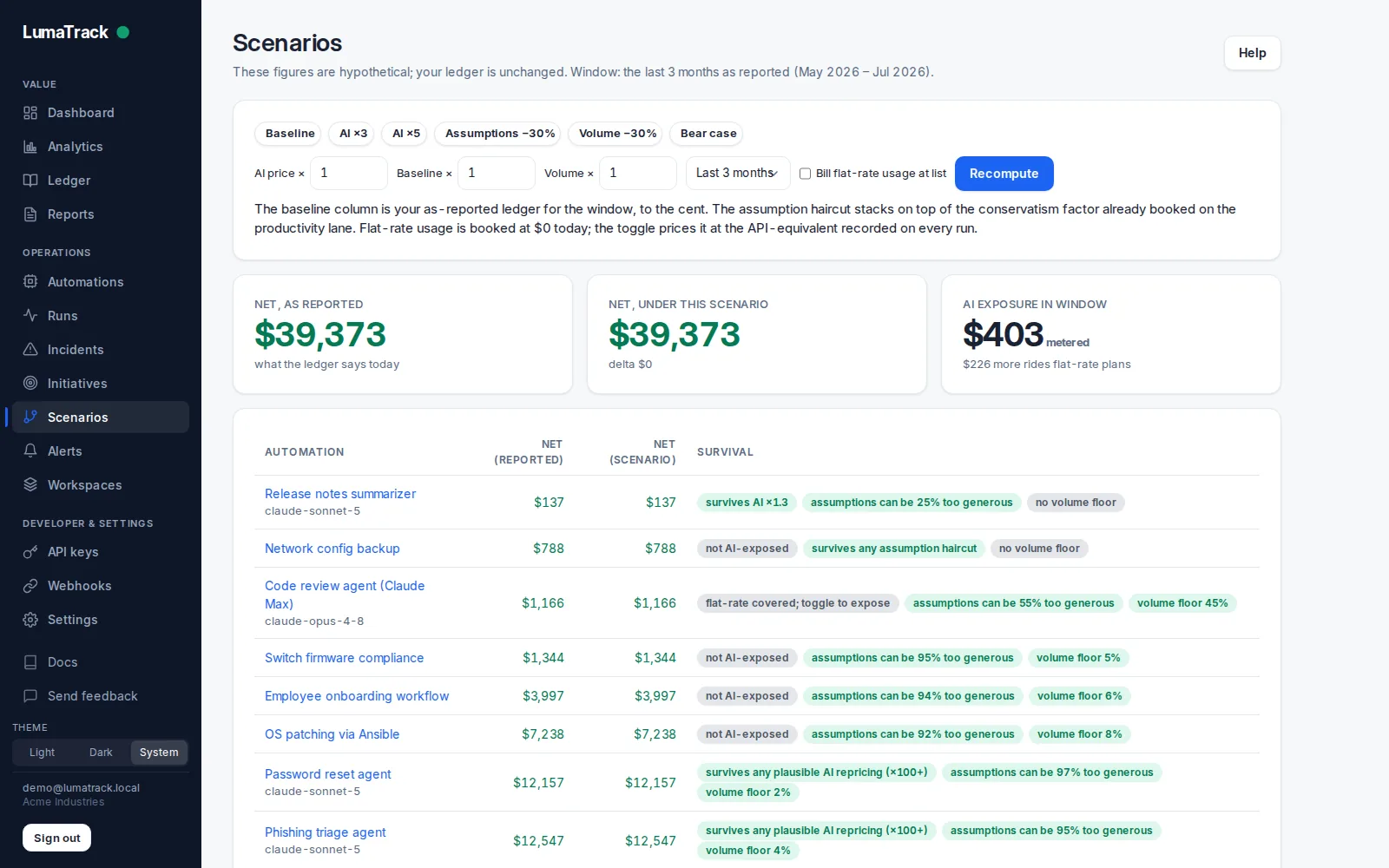
Read-only by construction, on Team and above. Closed months don't change, and no scenario ever rewrites a booked number.
Measured and asserted numbers stay separate.
Measured from your systems
Run counts, success and failure, timing, tokens, billed spend. All of it arrives through ingest and drills back to the raw event. Nobody inflates a headline with phantom runs, and failures are priced: they cost money and save nothing.
Asserted by you, labeled as an assumption
The human baseline (minutes, loaded rate, would-it-have-been-done) is your assumption. LumaTrack grades its evidence, discounts the productivity lane by a visible conservatism factor, settles it when the month closes, and lets finance change it and watch the number recompute.
Your agents already earned a number.
Find out what it is.
15 minutes to a first number · scenarios on Team $59/mo · full pricing.